
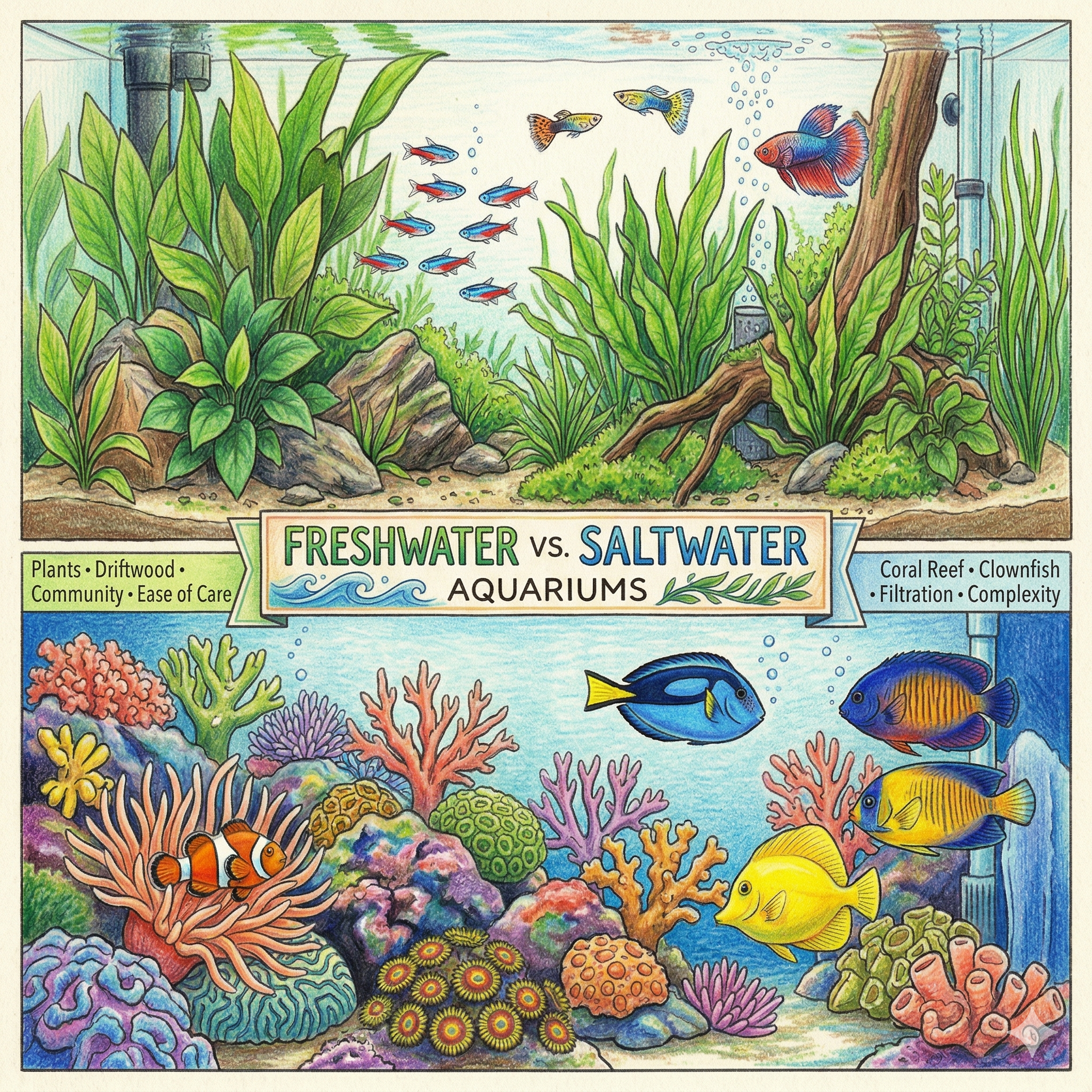
Freshwater vs Saltwater Aquariums: Which One Should You Start With?
One of the first real decisions in the aquarium hobby is whether to build a freshwater tank or a saltwater tank. This choice affects almost everything that comes after it: startup cost, livestock options, equipment needs, maintenance discipline, stocking pace, and how forgiving the system will be when you are still learning.
For most home aquarium owners and small-office setups in the USA, freshwater is the better first path. But that does not mean saltwater is a bad choice. Saltwater can be extremely rewarding when the owner is specifically motivated by marine fish or reef visuals and understands that the system usually requires tighter discipline and more expensive mistakes.
This guide compares freshwater and saltwater aquariums in practical terms so you can choose the right direction for your space, budget, and maintenance style.
Freshwater vs Saltwater at a Glance
| Category | Freshwater Aquarium | Saltwater Aquarium |
|---|---|---|
| Startup cost | Usually lower | Usually higher |
| Maintenance complexity | Easier for most beginners | More demanding and less forgiving |
| Fish options | Broad range of beginner-safe species | Visually striking species, but often more cost and care pressure |
| Equipment needs | Simpler overall | Often more specialized |
| Best for first tank? | Usually yes | Usually no, unless strongly motivated |
| Best fit | Practical home tanks, office tanks, beginner hobbyists | Dedicated hobbyists who want marine livestock and accept more work |
What Is the Real Difference?
Freshwater tanks use dechlorinated freshwater, simpler chemistry targets, and usually more forgiving fish and plant combinations. Saltwater tanks rely on prepared saltwater, salinity control, and a system where water chemistry, flow, and equipment coordination usually matter more.
The visual difference is obvious, but the practical difference matters more. Freshwater is generally easier to start, easier to stock, and easier to recover when something goes wrong. Saltwater often demands a slower, more deliberate build process.
Why Freshwater Is Usually the Better First Tank
1. Lower Cost of Entry
A good freshwater tank can be built with simpler equipment and lower livestock cost. You still need to spend responsibly, but you can usually get into the hobby without immediately buying salt mix, salinity tools, marine-specific livestock, and a more specialized support system.
2. Easier Water Management
Freshwater setups still need cycling, testing, and maintenance, but the chemistry demands are generally easier for beginners to understand and maintain.
3. More Beginner-Friendly Fish
Peaceful tetras, rasboras, corydoras, platies, and bettas give freshwater tanks a much wider beginner-safe starting range than most marine systems.
4. More Forgiving Learning Curve
Freshwater does not remove the need for discipline, but it gives most beginners more room to learn tank care, feeding, filter maintenance, and stocking without every small error feeling expensive.
Why Some People Still Choose Saltwater First
Saltwater is not only about prestige. Some hobbyists are specifically drawn to:
- clownfish and other marine fish
- reef-style aesthetics
- stronger specialty appeal
- the challenge of a more technical system
If that is the actual motivation, starting with saltwater can make sense. What does not make sense is choosing saltwater just because it seems more impressive while still wanting beginner-level simplicity.
Cost Comparison: Freshwater vs Saltwater
Freshwater Costs
Typical freshwater startup expenses include:
- tank and stand
- filter
- heater if tropical
- light
- substrate
- water conditioner
- test kit
- fish and optional plants
There is still a wide cost range, but most freshwater tanks let you scale up more gradually.
Saltwater Costs
Saltwater startup usually adds or increases:
- salt mix
- salinity testing and monitoring
- marine-ready filtration approach
- more expensive livestock
- slower and more careful stocking pace
Even “simple” saltwater tanks usually cost more than their freshwater equivalents.
Maintenance Comparison
Freshwater Maintenance
Freshwater tanks usually involve:
- regular water changes
- filter cleaning
- dechlorinated replacement water
- feeding management
- occasional algae control
This is real work, but it is usually manageable for a home owner with a practical weekly routine.
Saltwater Maintenance
Saltwater maintenance often adds:
- salinity stability concerns
- more equipment coordination
- more caution with water chemistry changes
- tighter livestock compatibility pressure
That does not mean every saltwater tank is overwhelming. It means the margin for sloppy maintenance is often smaller.
Equipment Differences
Freshwater Equipment
Most beginner freshwater tanks can succeed with:
- a HOB, sponge, or canister filter depending on size
- a heater for tropical species
- a basic light
- a test kit
You can keep the system relatively simple and still get very good results.
Saltwater Equipment
Saltwater systems can vary a lot, but they often demand a more deliberate equipment plan. Depending on the setup, you may care more about overall system design, flow, salinity handling, and marine-specific support gear.
For beginners, that additional system complexity is often the hidden factor that makes saltwater harder than expected.
Fish and Livestock Options
Freshwater Livestock
Freshwater gives beginners access to:
- peaceful community fish
- bettas
- livebearers
- corydoras
- planted-tank combinations
- some cichlid paths for later growth
This makes freshwater especially flexible for people who are still discovering what kind of aquarium they actually enjoy.
Saltwater Livestock
Saltwater offers:
- clownfish
- gobies
- royal grammas
- reef-focused visual appeal
- more specialized marine livestock paths
The visual reward is real, but the system asks more of the owner.
Best Choice by Situation
| Your Situation | Better Choice | Why |
|---|---|---|
| First aquarium ever | Freshwater | Best margin for error |
| Small office display | Freshwater | Easier maintenance and lower risk |
| Tight budget | Freshwater | Lower startup and livestock cost |
| Strong desire for clownfish or marine fish | Saltwater | Better to build for the fish you really want |
| Low-maintenance goal | Freshwater | Simpler ongoing routine |
| High motivation for a technical hobby | Saltwater | Better fit if you want the challenge |
Freshwater vs Saltwater by Tank Goal
Best for a Calm Family or Living Room Tank
Freshwater usually wins. You can create a peaceful, attractive display with community fish, live plants, and simple equipment.
Best for a Small Office
Freshwater usually wins again. The lower complexity and easier maintenance schedule make it a better fit for tanks that need to stay stable with limited weekly attention.
Best for Specialty Visual Impact
Saltwater has the edge if the owner specifically wants marine livestock and that reef-style look.
Best for a First Successful Experience
Freshwater is the stronger answer for most people.
Common Beginner Mistakes When Choosing Between Freshwater and Saltwater
Choosing Saltwater for the Wrong Reason
If the real goal is a low-stress first aquarium, saltwater is often the wrong choice. Pick it only if you actually want the marine path enough to support the extra work.
Underestimating Freshwater
Freshwater is not “boring beginner mode.” A well-planned freshwater aquarium can be planted, colorful, highly active, and visually impressive.
Buying Equipment Before Choosing the Direction
Do not buy random gear first and decide later. Start with the tank type, then build the equipment plan around it.
Thinking Cost Only Matters at Startup
Ongoing cost matters too. Livestock losses, consumables, specialty tools, and upgrade pressure can all make saltwater ownership more expensive over time.
Sample Decision Paths
Choose Freshwater If:
- this is your first aquarium
- you want the highest chance of early success
- you want more forgiving fish and simpler maintenance
- you want a home or office tank that feels practical
Choose Saltwater If:
- you specifically want marine fish
- you accept a higher cost and more deliberate maintenance approach
- you are willing to go slower and be more technical from the start
Final Thoughts
If you want the highest chance of success in your first aquarium, choose freshwater. It is usually less expensive, more forgiving, easier to stock, and a better fit for home and small-office tanks.
Choose saltwater only if you are specifically motivated by marine fish or reef-style visuals and you fully accept the higher maintenance and cost that usually come with that choice.
The best aquarium is not the one that looks most impressive on day one. It is the one you can actually maintain well over time.
Read Next
- Read the beginner tank setup guide if you are ready to start planning your first aquarium.
- Read the aquarium filter types guide if you still need help choosing equipment.
- Read the freshwater community fish guide if you are leaning toward a peaceful freshwater setup.
Keep moving from reading to action.
Use the related guides to go deeper, check the shop if you need matching accessories, or join the email list for new guides and product updates.
Get new guides, product updates, and practical aquarium planning notes by email without waiting to check back manually.
Use the contact page if you want direct help instead of general email updates.
Related Guides
Aquarium Filter Types Explained
Compare sponge, hang-on-back, canister, internal, and undergravel filters so you can choose the right aquarium filtration system for your tank size, fish, budget, and maintenance style. Real lessons from tanks in Norman, Oklahoma.
Aquarium Lighting Guide
Learn how to choose the right aquarium lighting for your home or office tank — intensity, spectrum, duration, timers, planted vs fish-only setups, and algae control. Real lessons from tanks in Norman, Oklahoma.
Aquascaping Basics: Creating Stunning Underwater Landscapes
Learn practical beginner aquascaping rules for home and office tanks — focal points, negative space, hardscape, plant grouping, and layouts that look intentional instead of cluttered. Real lessons from tanks in Norman, Oklahoma.